
BẢO TÀNG HẢI DƯƠNG HỌC
Museum of Oceanography
Thuyết minh tự động
Audio Guides
MẪU VẬT TRƯNG BÀY
Exhibit Specimens

Bộ xương Cá voi lưng gù
Humback Whale Skeleton
Bộ xương này được phát hiện ngày 08/12/1994 tại xã Hải Cường (Hải Hậu, Nam Hà), nằm sâu khoảng 1,2m dưới ruộng và cách biển 4km. Bộ xương dài 18m, nặng gần 10 tấn.
This skeleton was discovered on December 8, 1994, in Hai Cuong Commune (Hai Hau, Nam Ha). It was buried 1.2 meters underground and located 4 km from the sea. The skeleton measures 18 meters and weighs nearly 10 tons.

Bò biển
Sea Cow
Mẫu bò biển này được chuyển về Viện Hải dương học sau khi chết do mắc lưới tại vùng biển Phú Quốc ngày 23/12/2002. Sau một năm xử lý và bảo quản trong formol, mẫu được đưa vào bể kính trưng bày. Đây là mẫu bò biển còn nguyên vẹn đầu tiên tại Việt Nam.
This dugong specimen was transferred to the Institute of Oceanography after dying from net entanglement off Phu Quoc on December 23, 2002. After a year of formalin preservation, it was placed in a display tank. This is the first intact dugong specimen ever preserved in Vietnam.

Cá Tầm Trung Hoa
Chinese Sturgeon
Mẫu cá tầm Trung Hoa này được ngư dân Hàm Tân (Bình Thuận) cứu hộ năm 1977. Sau đó, mẫu được chuyển giao cho Viện Hải dương học để nghiên cứu và trưng bày.
This Chinese sturgeon specimen was rescued by fishermen in Ham Tan (Binh Thuan) in 1977. It was later transferred to the Institute of Oceanography for research and display.

Hàm răng Cá mập
Shark jaws
Mẫu vật này được thu từ ngư dân tại cảng Nha Trang năm 2015. Trong quá trình đánh bắt, ngư dân chỉ giữ lại phần có giá trị như vi hoặc đầu cá, nên bảo tàng chỉ tiếp nhận được phần hàm, gây khó khăn cho việc định loại.
This specimen was obtained from fishermen at Nha Trang Port in 2015. Only the jaws were recovered—fishermen typically keep valuable parts such as fins—making species identification difficult.

Hải cẩu đốm
Spotted seals
Hai mẫu hải cẩu Đốm này được cứu hộ vào năm 1998 tại Quảng Ngãi và Quảng Bình, nay là Quảng Trị. Đây là loài không phân bố ở vùng biển nhiệt đới Việt Nam; các cá thể này được cho là bị lạc đàn khi trôi theo dòng hải lưu Bắc–Nam.
These two Spotted Seal specimens were caught in 1998 in Quang Ngai and Quang Binh, now Quang Tri. Although the species does not inhabit tropical Vietnamese waters, these individuals were likely stragglers carried southward by the North–South currents.

Cá Thu song
Seerfish
Mẫu cá Thu Song (Seerfish) này được ngư dân Nha Trang đánh bắt tại vùng biển Trường Sa vào ngày 11/02/2011, có chiều dài 2,4 m và nặng 70 kg, gần chạm kỷ lục thế giới (2,47 m).
This Seerfish specimen was caught by Nha Trang fishermen in the waters of the Spratly Archipelago on February 11, 2011. Measuring 2.4 m in length and weighing 70 kg, it nearly reached the world record size (2.47 m).

Rùa da
Leatherback Turtle
Rùa Da là loài rùa biển lớn nhất thế giới, dài 1–2 m và nặng 250–700 kg, cá thể lớn nhất từng ghi nhận đạt 916 kg. Đây là loài rùa phân bố rộng nhất toàn cầu, xuất hiện từ vùng nhiệt đới đến ôn đới, và tại Việt Nam từng ghi nhận ở Đồ Sơn, Nha Trang, Phú Quốc và Côn Đảo.
The Leatherback Turtle is the largest sea turtle, measuring 1–2 m and weighing 250–700 kg, with the largest recorded at 916 kg. It has the widest global range of all sea turtles and has been recorded in Vietnam at Do Son, Nha Trang, Phu Quoc, and Con Dao.

Rùa xanh
Green Turtle
Rùa Xanh phân bố rộng ở các vùng biển nhiệt đới và cận nhiệt đới. Chúng đóng vai trò quan trọng trong việc duy trì thảm cỏ biển nhưng hiện đang suy giảm mạnh vì khai thác, mắc lưới, mất bãi đẻ và biến đổi khí hậu.
The Green Turtle is widely distributed in tropical and subtropical waters. They play a key role in maintaining healthy seagrass beds but are declining due to hunting, bycatch, habitat loss, and climate change.

Vích
Olive Ridley Turtle
Vích là loài rùa biển nhỏ, phổ biến nhất thế giới, phân bố chủ yếu ở vùng biển nhiệt đới và cận nhiệt đới. Số lượng Vích giảm mạnh trong vài thập kỷ qua và hiện được xếp vào nhóm dễ bị tổn thương theo IUCN và Phụ lục I CITES.
The Olive Ridley Turtle is a small, abundant sea turtle found in tropical and subtropical oceans. Due to declining populations, the species is listed as Vulnerable (IUCN) and CITES Appendix I.

Đồi mồi
Hawksbill Turtle
Đồi mồi là loài rùa biển có chiếc mai dạng cưa đặc trưng và hoa văn đẹp, dễ nhận biết nhờ chiếc mỏ cong sắc như mỏ diều hâu. Đồi mồi bị săn bắt nặng nề để lấy mai làm đồ mỹ nghệ, khiến quần thể suy giảm nghiêm trọng và trở thành loài nguy cấp theo CITES.
The Hawksbill Turtle is easily recognized by its beautifully patterned, saw-edged shell and its sharp, hooked beak. Intense hunting for its ornate shell—used in jewelry and crafts—has led to severe population declines, making the species critically endangered under CITES.
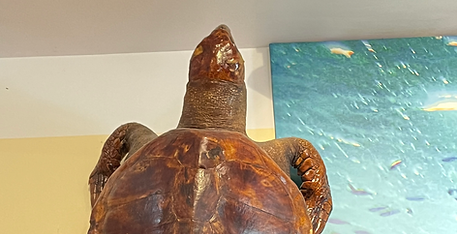
Đú/ Quản đồng
Longgerhead Turtle
Đú, hay Rùa Quản đồng, là loài rùa biển đầu lớn phân bố rộng ở vùng biển nhiệt đới và cận nhiệt đới. Ở Việt Nam, loài này gặp rải rác nhưng không còn ghi nhận sinh sản từ thập niên 1970. Do tuổi thọ dài, sinh sản chậm và tỉ lệ chết non cao, Đú được xếp vào nhóm nguy cấp và bị cấm khai thác, mua bán theo CITES.
The Loggerhead Turtle is a large-headed sea turtle widely distributed across tropical and temperate oceans. In Viet Nam it is occasionally encountered but has not been recorded nesting since the 1970s. Due to slow reproduction and high juvenile mortality, the species is listed as endangered and strictly protected under CITES.

Cá Nhám thu
Shortfin Mako Shark
Cá Nhám thu được xem là loài cá mập nhanh nhất thế giới (tốc độ tới 70 km/h), chúng năng động và thường lên gần mặt nước. Cá Nhám thu hiếm khi tấn công người, nhưng do khai thác quá mức, loài này được IUCN xếp vào nhóm dễ bị tổn thương (Vulnerable).
The Shortfin Mako Shark is known as the fastest shark, it can reach speeds up to 70 km/h and is highly active, often swimming near the surface. Despite its power, only three attacks on humans have been reported since 1974. Due to overfishing, the species is listed as Vulnerable by the IUCN.

Cá Nhám búa vây đen
Scalloped Hammerhead Shark
Cá Nhám Búa Vây Đen có chiếc đầu dẹt đặc trưng giúp quan sát gần như 360°, phân bố rộng ở vùng biển nhiệt đới và ôn đới ấm. Mẫu vật này được thu trong nghiên cứu về hiện tượng cá dữ tấn công người tắm biển ở Quy Nhơn. Dù không quá nguy hiểm, loài này đang suy giảm mạnh do bị khai thác để lấy vây và sụn, và được IUCN xếp vào nhóm nguy cơ tuyệt chủng cao.
The Scalloped Hammerhead has a distinctive widened, flattened head that provides near-360° vision and occurs widely across tropical and warm-temperate seas. This specimen was collected during research on aggressive shark incidents in Quy Nhon Bay. Although not highly dangerous, the species is severely threatened by fin and cartilage exploitation and is listed by the IUCN as Endangered.

Cá Nhám góc mõm dài
Japanese Spurdog Shark
Cá Nhám Góc Mõm Dài phân bố ở vùng biển sâu Tây Bắc Thái Bình Dương, từ Nhật Bản, Trung Quốc đến Việt Nam. Chúng sống ở độ sâu 50–400 m, thường ẩn mình dưới đáy cát nên hầu như không gây nguy hiểm cho con người. Do sinh sản ít và bị khai thác quá mức, số lượng của chúng đã giảm mạnh; IUCN xếp loài này vào nhóm có nguy cơ tuyệt chủng.
The Japanese Spurdog occurs in deep waters of the Northwest Pacific, from Japan and China to Vietnam. Living at depths of 50–400 m, it hides along sandy bottoms and poses virtually no danger to humans. With low reproductive rates and heavy fishing pressure, its population has declined sharply; the IUCN lists the species as Endangered.

Cá Mập vây đuôi có chấm
Spottail Shark
Cá Mập Vây Đuôi Có Chấm phân bố rộng khắp vùng biển nhiệt đới Ấn Độ–Thái Bình Dương, thường sống gần đáy và quanh rạn san hô. Loài này săn cá xương và giáp xác, ban ngày ở đáy biển, ban đêm lên tầng mặt. Dù không gây nguy hiểm cho con người, chúng đang Gần bị đe dọa (IUCN) do đánh bắt và suy thoái môi trường sống.
The Spottail Shark is widely distributed across tropical Indo–Pacific waters, living near the seafloor and coral reefs. It feeds on bony fish and crustaceans, staying near the bottom by day and rising to the surface at night. Harmless to humans, it is listed as Near Threatened (IUCN) due to overfishing and habitat decline.

Cá Mập da trơn
Silky Shark
Cá Mập Da Trơn phân bố rộng ở các vùng biển nhiệt đới và cận nhiệt đới trên thế giới, sống từ tầng mặt đến độ sâu 500 m. Tuy không thường tấn công người, chúng được xem là loài có nguy cơ suy giảm mạnh do bị đánh bắt quá mức. IUCN xếp Cá Mập Da Trơn vào nhóm Gần bị đe doạ (Near Threatened).
The Silky Shark is widely distributed in tropical and subtropical oceans, living from surface waters down to about 500 m. Although not typically dangerous, the species has declined significantly due to heavy fishing pressure. The IUCN lists the Silky Shark as Near Threatened.
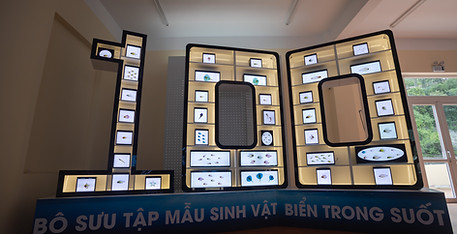
Bộ sưu tập mẫu sinh vật biển trong suốt
Collection of transparent marine specimens
Bộ sưu tập sinh vật biển trong suốt đầy sắc màu này được giới thiệu nhân dịp kỷ niệm 100 năm thành lập Viện Hải dương học (1922–2022). Khoảng 30 mẫu cá xương và cá sụn được chế tác bằng kỹ thuật nhuộm xương – sụn và làm trong suốt hiện đại.
This vibrant collection of transparent marine specimens was created to celebrate the 100th Anniversary of the Institute of Oceanography (1922–2022). It features around 30 bony and cartilaginous fish specimens prepared using modern bone–cartilage staining and clearing techniques.

Bộ sưu tập "Sắc màu đại dương"
Collection "Colors of the Ocean"
Bộ sưu tập “Sắc Màu Đại Dương” gồm 70 tác phẩm rong biển, được chế tác từ các mẫu rong thu thập dọc biển Việt Nam nhằm tôn vinh vẻ đẹp của gần 850 loài rong biển. Điểm nhấn là bức “Cá Mao Tiên” ghép từ nhiều loài rong. Bộ sưu tập ra đời nhân kỷ niệm 100 năm Viện Hải dương học (1922–2022), kết hợp hài hòa giữa khoa học và nghệ thuật.
The “Colors of the Ocean” collection features 70 seaweed artworks created from specimens gathered along Vietnam’s coast, celebrating the beauty of nearly 850 recorded seaweed species. The highlight is the large “Lionfish” piece crafted from multiple algae types. Produced for the Institute’s 100th anniversary (1922–2022), the collection blends scientific technique with artistic expression.

Bộ sưu tập Rắn biển Việt Nam
Sea Snakes of Viet Nam Collection
Bộ sưu tập Rắn biển Việt Nam trưng bày 26 loài trong tổng số 62 loài trên thế giới, là một trong những bộ sưu tập đầy đủ nhất cả nước. Bộ sưu tập cung cấp nguồn mẫu chuẩn cho nghiên cứu – giáo dục và góp phần nâng cao nhận thức về đa dạng sinh học và vai trò sinh thái của rắn biển tại Việt Nam.
This collection presents 26 of the world’s 62 sea snake species, making it one of the most complete in Viet Nam. The collection serves as an essential scientific reference and helps raise awareness of marine biodiversity and the ecological importance of sea snakes in Viet Nam.

Cá sấu nước mặn
Saltwater Crocodile
Tại khu Rừng ngập mặn, Bảo tàng Hải dương học đang chăm sóc 3 cá thể Cá sấu nước mặn – loài bò sát lớn nhất thế giới và gần như đã tuyệt chủng ngoài tự nhiên ở Việt Nam. Các cá thể này được tiếp nhận giai đoạn 2018–2020, hiện đều trưởng thành và khỏe mạnh. Ba cá thể cá sấu mang sứ mệnh bảo tồn nguồn gen quý hiếm và nâng cao nhận thức về bảo vệ động vật hoang dã.
In the Mangrove Zone, the Institute of Oceanography is caring for three Saltwater Crocodiles—the world’s largest living reptiles, now nearly extinct in the wild in Viet Nam. These individuals were received between 2018 and 2020 and are now fully grown. These crocodiles play an important role in conserving a rare genetic lineage and raising public awareness of wildlife protection.

Trai tai tượng khổng lồ
Giant Clam
Trong chuyến khảo sát Việt Nam – CHLB Nga năm 1981 tại đảo Sinh Tồn (quần đảo Trường Sa), các nhà khoa học đã thu được một mẫu Trai tai tượng khổng lồ nặng 145 kg và dài gần 1 m. Kết thúc khảo sát, Viện Hải dương học giữ một mảnh (đang trưng bày), và Viện Tài nguyên & Môi trường Biển giữ một mảnh còn lại. Trai tai tượng là loài đặc hữu ở Trường Sa và được xếp vào nhóm Nguy cấp trong Sách Đỏ Việt Nam.
During the 1981 Vietnam–Russia survey at Sin Cowe Island in the Spratly Archipelago, scientists collected a giant clam specimen weighing 145 kg and nearly 1 m long. After the survey, one piece was kept by the Institute of Oceanography (now on display), and the other by the Institute of Marine Resources and Environment. The giant clam is endemic to the Spratly region and is listed as Endangered in the Vietnam Red Data Book.
Apply Today
This is a Paragraph. Click on "Edit Text" or double click on the text box to start editing the content.
123-456-7890